
 EN
EN EN
EN CN
CN ES
ES PT
PT SV
SV DE
DE TR
TR FR
FR AR
AR BG
BG HR
HR CS
CS DA
DA NL
NL FI
FI EL
EL HI
HI IT
IT JA
JA KO
KO NO
NO PL
PL RO
RO RU
RU CA
CA TL
TL IW
IW ID
ID LV
LV LT
LT SR
SR SK
SK SL
SL UK
UK VI
VI SQ
SQ ET
ET GL
GL HU
HU MT
MT TH
TH FA
FA AF
AF MS
MS GA
GA BE
BE UZ
UZ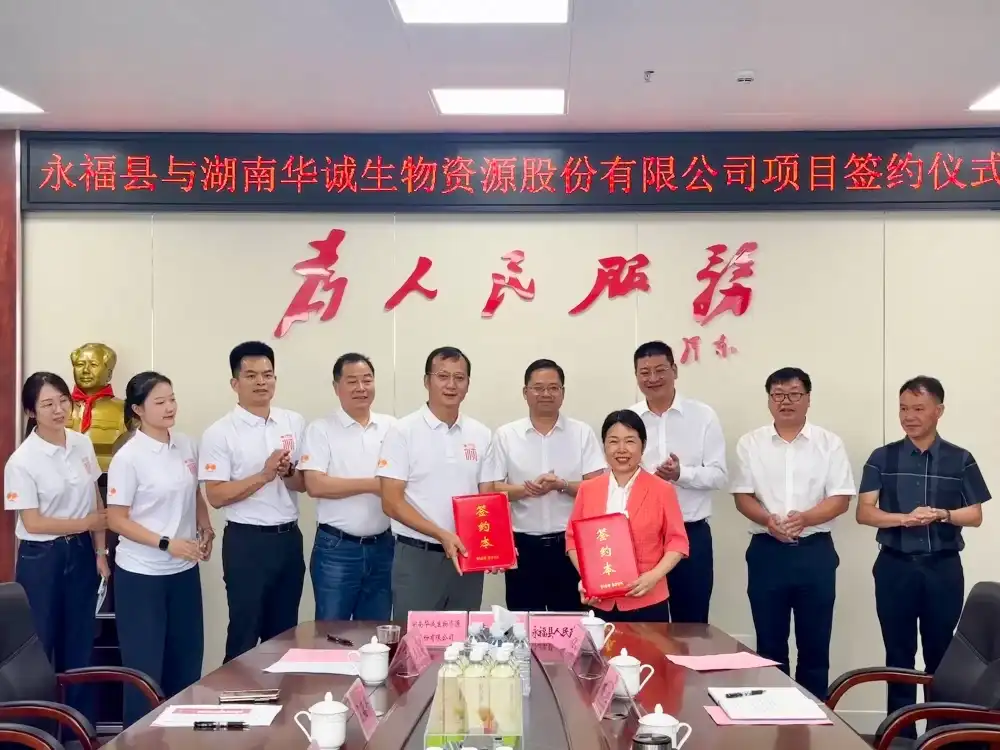
Huacheng Bio: Building Momentum for the Future, Sharing New Beginnings
Huacheng Bio has officially entered a new chapter with the formal establishment of its new...
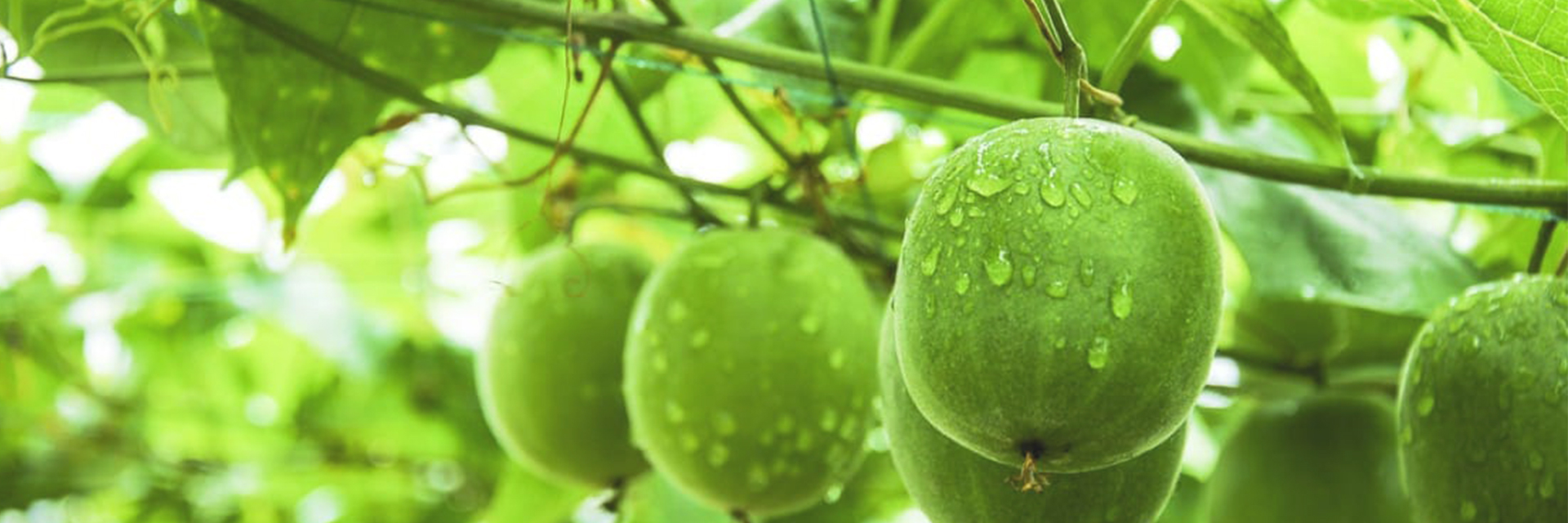
Pure Beta Ecdysterone: From Extraction to Application
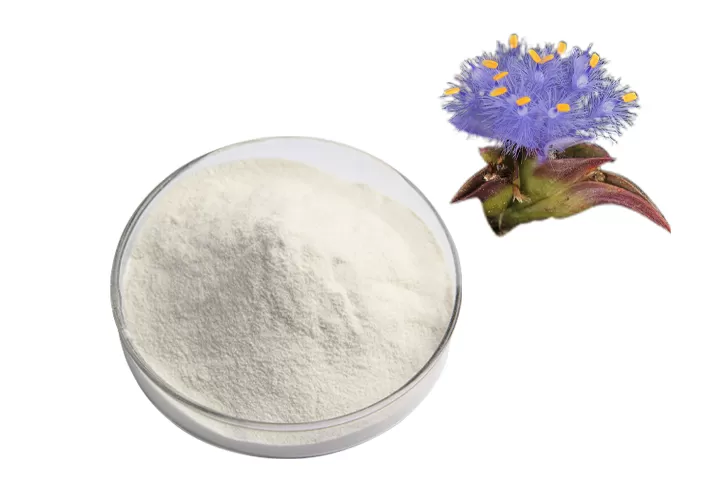
Beta-ecdysterone’s story starts in plants like Cyanotis arachnoidea, where it helps insects molt. For humans, it’s become a non-hormonal muscle building tool; for growers, a way to push crop resilience. ‘Pure’ here isn’t just a label—it defines whether your supplement passes HPLC testing or your field trial shows consistent results. Most bulk material ranges from 90% to 95% purity, and that gap matters more than it looks on paper. At Huacheng Biotech, we keep the supply chain short—sourcing raw herbs directly and running extraction in-house—to control quality without the markup that usually comes with it. That lean setup means you can spec a 90% powder for a mid-range product or go up to 95% for a premium capsule, and the per-kilo price won’t shock your R&D budget. The extract is a light brown powder, soluble in ethanol, and typically ships with a certificate of analysis that shows heavy metals below EU limits.
Technical Detail
Beta-ecdysterone is a phytosteroid found in spinach, quinoa, and specifically in Cyanotis arachnoidea—a plant we process at scale. The extraction uses ethanol-water gradient separation; by adjusting the solvent ratio, we pull a concentrate that carries 90%, 95%, or even 98% ecdysterone content depending on customer requirement. Why does the purity jump matter? At 90%, you will still see about 5–7% related ecdysteroids (like ecdysone) that can skew your HPLC trace. At 95%, those side peaks shrink below 2%, giving you a cleaner label and more predictable dosing in a pre-workout blend. This detail often gets overlooked when buyers chase the lowest price. Our approach cuts cost by ownership of the whole process: plantation in Hunan, extraction workshop, and in-line QA under GMP. That means you aren’t paying multiple margins from an intermediary. The powder is vacuum-dried and milled to 80 mesh for easy mixing into capsules or dry shakes. For agricultural use, the same molecule works as a biostimulant—it turns on genes related to stress tolerance without being a synthetic hormone. Growers in Europe are using it at 0.05% spray concentration to offset drought stress in lettuce and tomatoes, and we provide a technical data sheet with solubility and storage guidance. Huacheng Biotech doesn’t see itself as just a supplier; the aim is to be your in-house extraction arm. We hold FDA registration, HACCP, GMP, and BRC certification, so the paperwork already meets North American and EU expectations. Batch sizes range from 25 kg to full container loads, and we keep a safety stock of 95% purity in our Changsha warehouse for fast sampling. When you email our team, you get a direct line to a process engineer—not a sales bot—who can walk you through the UV-Vis quantification method and help you interpret the COA before your order.
News
Huacheng Bio has officially entered a new chapter with the formal establishment of its new...
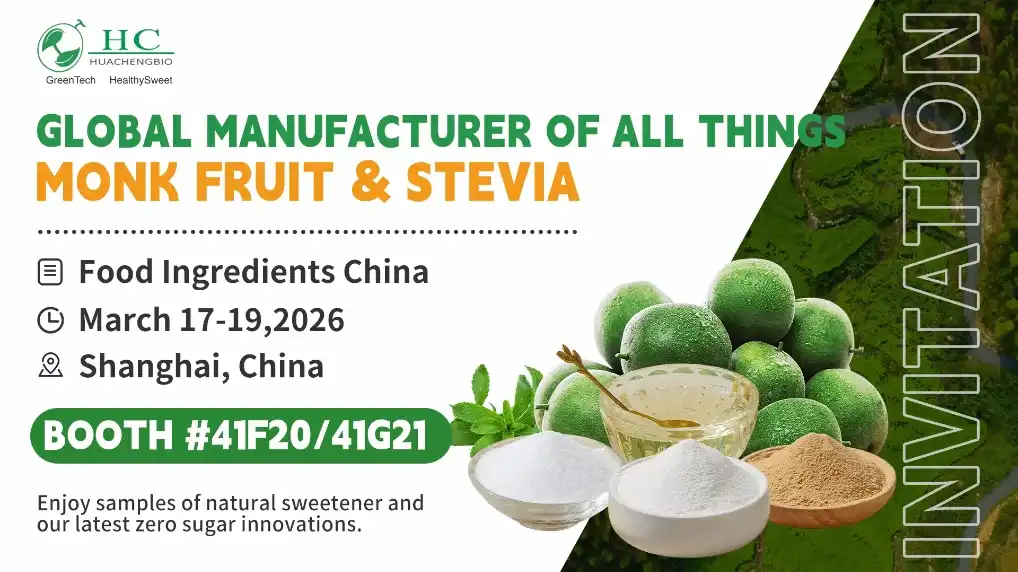
Join Us at Food Ingredients China (FIC) 2026! March 17–19, 2026 Hall 4.1 | Booth...

As a global leader in natural, health‑forward sweetening solutions, we will be present at ...
Products
FAQ
You will see offers from 50% up to 98%. At 50%, it’s a crude extract with lots of inert plant matter—fine if you just want ‘spinach extract’ on the label. For muscle-building supplements, 90% is the floor; most brands use 95% because it dissolves better in ethanol and lets you claim a higher dosage per capsule without bulking up the pill. At 95% HPLC, the remaining 5% is moisture, small amounts of ecdysone, and trace lipids. We recommend 95% for capsules because it blends evenly in a V-mixer and flows well on automatic filling machines.
The molecule itself is natural, but whether your final product gets an organic logo depends on the certifying body and the extraction solvents used. Our default process uses food-grade ethanol, which is accepted under many organic schemes. If you need EU organic or USDA NOP, we can switch to certified organic raw herbs and adjust our paperwork chain—there will be a price premium, but it’s doable. Ask your certifier about permitted extraction aids before ordering; we have seen clients get stuck because the auditor didn’t like the synthetic anti-foaming agent used during concentration (we can run without it).
We use HPLC-UV with a C18 column, mobile phase acetonitrile-water, and detection at 248 nm. The reference standard is USP-grade beta-ecdysterone. Each batch comes with a COA showing retention time, peak area, and the final percentage calculated against the standard curve. For customers who want extra confidence, we also run a moisture content (Karl Fischer), heavy metals (ICP-MS), and microbiology panel on every 25 kg drum. The COA is shared before shipment so your incoming QC can match the data.
In original vacuum-sealed foil bags at room temperature (below 25°C), the powder is stable for 24 months from the date of manufacture. Once opened, transfer it to an airtight container with desiccant and keep it away from direct light. Humidity is the enemy—it will clump and slowly degrade. We recommend re-testing after 6 months if repackaged. For liquid formulations, store the solution in ethanol at 2–8°C and use within 30 days.
We own the whole chain—from planting Cyanotis arachnoidea in Hunan to the finished powder—so there is no middleman adding cost. The production line runs under GMP with HACCP, and our facility is FDA registered. Price-wise, we sit in the ‘budget’ range without cutting UV purity. Minimum order is one drum, but we give the same batch-level testing to a 25 kg trial as we do to a 1000 kg order. Most customers stay because the COA tells the truth and delivery happens within the window we promised.
Share your product type, target capacity, and application requirements. Our team can review the details and recommend a practical next step.
Related Keywords