
Monk fruit extract helps a food or beverage team bring the sugar number down without putting sugar back. That is the part it can do. Whether the finished product can be called healthier is settled elsewhere: by the nutrient thresholds in the destination market, by the exact wording on the pack, and by the documents behind the ingredient. A "healthier" brief is a claim waiting to be audited, so work backwards from the claim to the grade and the dose.
The thresholds are numeric and jurisdiction-specific, and the evidence sits in layers: an ingredient's GRAS record or specification sheet occupies only one. Below are the numbers a claim has to clear, the parts a monk fruit supplier can document, and a pre-launch review to run before artwork is approved.
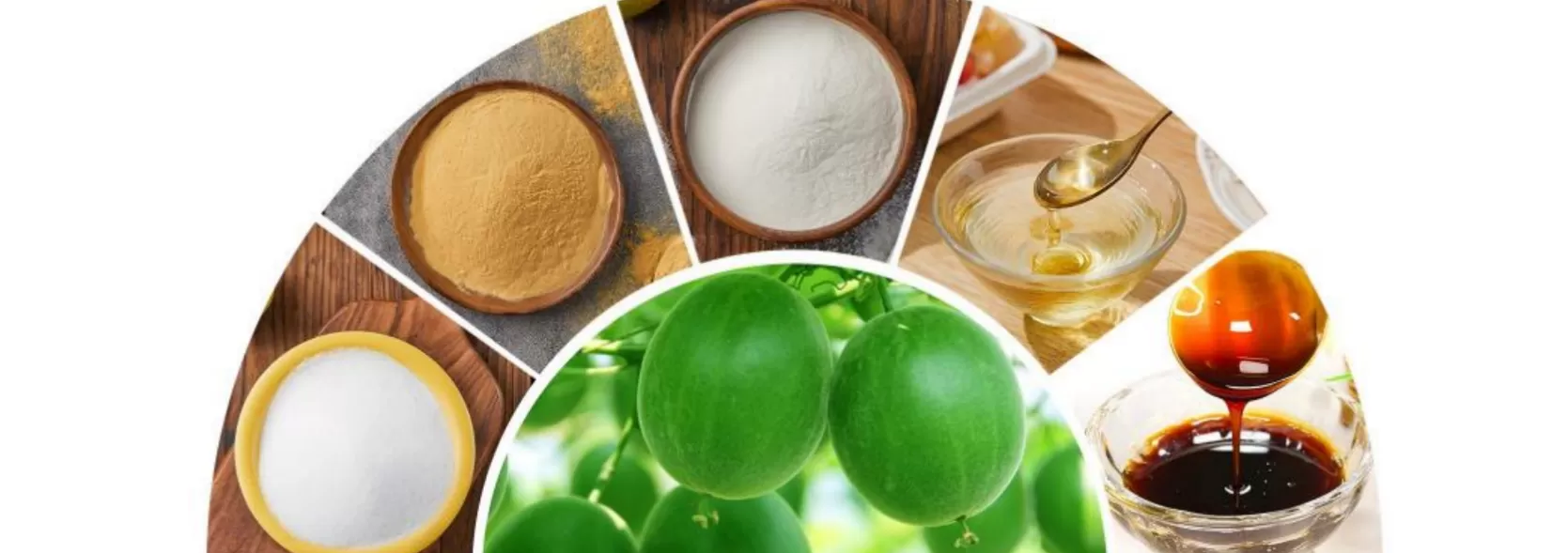
Huacheng Bio's overview of application potential maps the categories where monk fruit extract is used. Every threshold below applies to the finished product inside those categories, and none of them is written about an ingredient.
| Market | Wording on the pack | Threshold | What has to be measured |
|---|---|---|---|
| EU | "low sugar" | No more than 5 g sugars per 100 g for solids, 2.5 g per 100 ml for liquids | Finished-product sugars per 100 g or 100 ml |
| EU | "sugar-free" | No more than 0.5 g sugars per 100 g or 100 ml | The same figure at a tighter limit |
| EU | "reduced sugars" | At least 30% less than a similar product; energy no higher than that product | Sugars and energy for both products |
| US | "sugar free" | Less than 0.5 g sugars per reference amount and per labeled serving, plus a calorie-related statement | Serving size and sugars per serving |
| US | "reduced sugar" | At least 25% less sugar per reference amount than an appropriate reference food; declare that food, the percentage difference and a quantitative comparison | Reference food identity and both sugar values |
| US | "no added sugar" | No sugars or sugar-containing ingredients added during processing, no increase in sugars content, and a statement pointing to the nutrition panel | Ingredient list and process record |
Regulation (EC) No 1924/2006 sets the EU conditions, with the energy condition for "reduced sugars" added by Commission Regulation (EU) No 1047/2012. In the United States, 21 CFR 101.60(c) sets the sugar claims. These lines are planning summaries; have your regulatory reviewer read the current text. A beverage application is measured per 100 ml and a solid snack per 100 g, so the arithmetic changes with the format.
An ingredient supplier can help with two layers of this evidence. The rest belongs to the finished product.
Huacheng Bio's H2-Luo extract powder is specified from 1.5% to 98% Mogroside V by HPLC, with an 80-mesh particle size and heavy metal and arsenic limits. A certificate of analysis tied to that grade and lot is the document your reviewer will read.
The concentrated juice runs at 1% to 10% Mogroside V, with grades from one to eighteen times the sweetness of sugar and a pH of 3.5 to 7.0 at 65 to 70 Brix. The blend sweetener runs at one to four times sugar and is supplied with erythritol, stevia plus erythritol, allulose, dietary fibre or other carriers. Both formats change what your nutrition calculation has to include.
None of those sheets gives the finished product's sugar, energy or carbohydrate value, and no published grade specification states a sugars or carbohydrate figure. Ask for those values for the exact grade, plus the carrier composition of any blend, before you calculate the panel. A fruit-derived concentrate and a polyol or fibre carrier can each move the numbers.
For market permission, FDA's GRAS notice inventory records GRN 556 for Luo Han Guo fruit extract, notified by Hunan Huacheng Biotech and closed on 17 June 2015, for table-top and general-purpose sweetener use in foods other than infant formula and meat and poultry products. It is an ingredient-level record with a defined condition of use and carries no permission for pack wording.
WHO's 2023 guideline conditionally recommends against using non-sugar sweeteners for weight control, on low-certainty evidence, and excludes people with pre-existing diabetes as well as low-calorie sugars and polyols. Its definition covers naturally derived non-nutritive sweeteners. Any copy implying a weight or health benefit needs a market-by-market review. An ingredient description cannot be carried across to a finished-product label.
Four situations should stop the artwork, or the project, before it reaches a printer.
Work down this sequence and freeze the wording before artwork is approved.
Send the first three items to the supplier together. A document request that omits the claim and the market tends to come back as a generic data sheet, which your reviewer cannot use.
Send the destination market, product category, current and target sugar levels, the claim you want to make, and the format you are considering. We can confirm which H2-Luo grade fits the brief, supply its current specification, and confirm which composition data can be provided for that grade and which documents would accompany a sample.
Request a claim and documentation reviewIt can lower the sugar contribution while keeping sweetness. Whether the product qualifies for a nutrient or health claim depends on the finished product's composition and the rules in its market. WHO's 2023 guideline conditionally recommends against using non-sugar sweeteners for weight control, so a health benefit cannot be inferred from the ingredient.
In the EU, Regulation (EC) No 1924/2006 requires at least 30% less than a similar product, and for "reduced sugars" the product's energy must be no higher than that similar product. In the US, 21 CFR 101.60(c) requires at least 25% less sugar per reference amount than an appropriate reference food, with the reference food, the percentage difference and a quantitative comparison declared. Have your reviewer confirm the current text and the reference food.
Treat it as a separate regulatory project. EFSA concluded in 2019 that the toxicity database was insufficient to conclude on safety and could not establish a health-based guidance value. Confirm the current position for your category and use level before any EU artwork is commissioned.
Grade specifications give Mogroside V assays and carrier options for blends, with no sugars or carbohydrate value. Ask for those figures for the exact grade, plus the carrier composition, and use them in your own nutrition calculation. Treat ingredient-page wording as product description and the finished-product analysis as the panel number.
Send the market, category, current and target sugar levels, the exact claim wording, and the H2-Luo format under consideration. Request the current specification, a certificate of analysis tied to a recent commercial lot, the issuing body, scope, validity and covered site for each certificate, and the grade-specific sugars and carbohydrate data. Confirm what accompanies a production order.







 EN
 EN
 CN
 ES
 PT
 SV
 DE
 TR
 FR
 AR
 BG
 HR
 CS
 DA
 NL
 FI
 EL
 HI
 IT
 JA
 KO
 NO
 PL
 RO
 RU
 CA
 TL
 IW
 ID
 LV
 LT
 SR
 SK
 SL
 UK
 VI
 SQ
 ET
 GL
 HU
 MT
 TH
 FA
 AF
 MS
 GA
 BE
 UZ