
 EN
EN EN
EN CN
CN ES
ES PT
PT SV
SV DE
DE TR
TR FR
FR AR
AR BG
BG HR
HR CS
CS DA
DA NL
NL FI
FI EL
EL HI
HI IT
IT JA
JA KO
KO NO
NO PL
PL RO
RO RU
RU CA
CA TL
TL IW
IW ID
ID LV
LV LT
LT SR
SR SK
SK SL
SL UK
UK VI
VI SQ
SQ ET
ET GL
GL HU
HU MT
MT TH
TH FA
FA AF
AF MS
MS GA
GA BE
BE UZ
UZ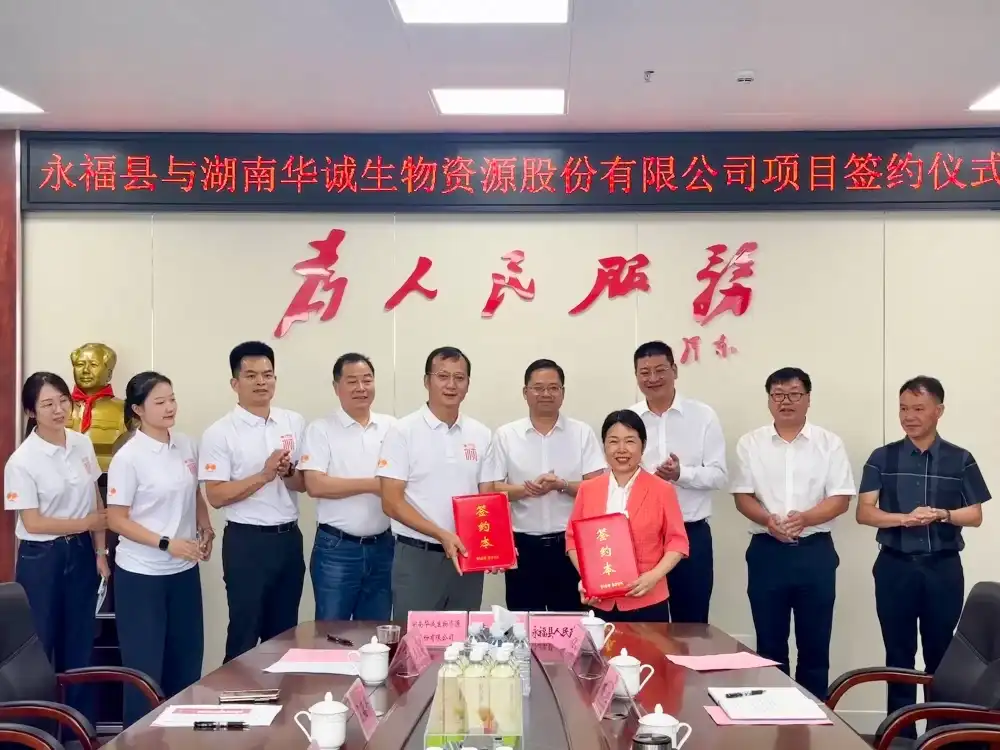
Huacheng Bio: Building Momentum for the Future, Sharing New Beginnings
Huacheng Bio has officially entered a new chapter with the formal establishment of its new...
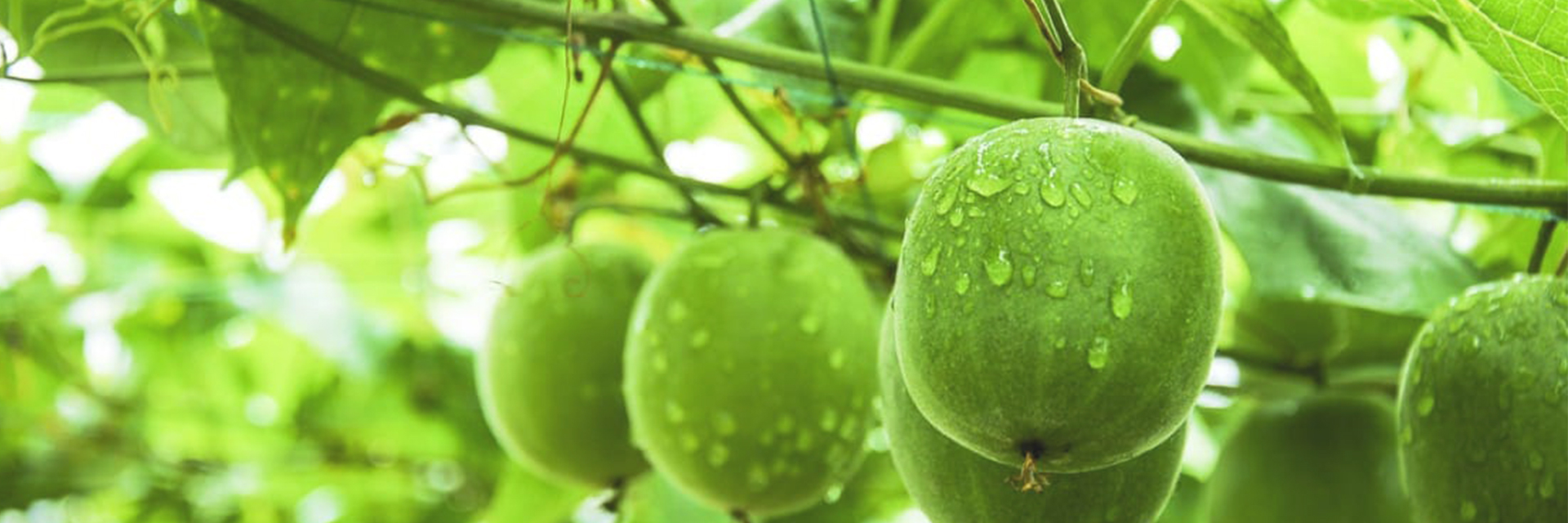
Monk Fruit Sweetener Sample: Technical Specs on a Budget
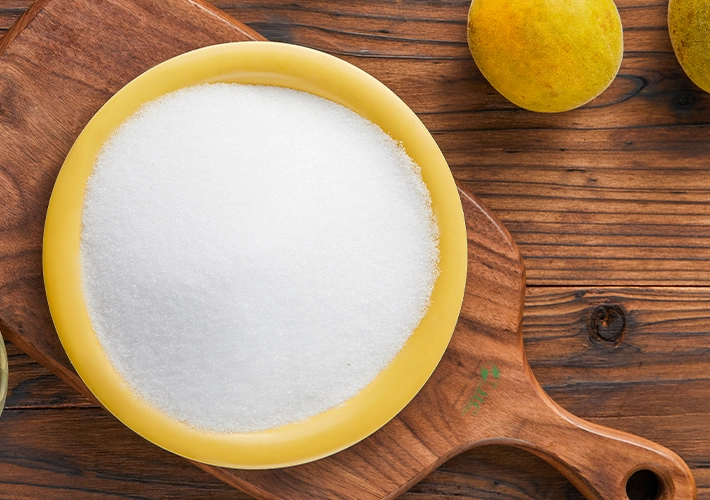
Getting a monk fruit sweetener sample from us isn’t about glossy brochures. You receive the actual powder we produce at our Hunan extraction plant—same spec, same flowability, same lot-to-lot consistency you’d get in a commercial order. We ship it with a straightforward COA and let it speak for itself. Our chain runs from contract farms in the region to in-house refining, so we control costs at every link. That shows up in pricing that works for budget-driven projects, and in technical parameters you can stress-test in your own lab. The sample is a dry, off-white powder milled to 80 or 200 mesh; specify which you prefer. Certifications FDA, HACCP, GMP, CE, BRC are all in place, so you can push it straight to your QA team. We keep the sample program simple: technical ingredient, real documentation, no hidden fees (you cover freight). No marketing follow-ups, no sales pitches—just the material and data you need to decide if it fits your formula.
Technical Detail
Hunan Huacheng Biotech runs a fully integrated monk fruit supply chain—seedlings, harvesting, extraction, spray drying, all under one management. This vertical setup is why our monk fruit sweetener sample comes at a price point that leaves room in your R&D budget, without cutting corners on purity or consistency. The sample ships with a certificate of analysis that lists mogroside V content—standard options are 50% or 80%, but tell us your target—plus moisture, ash, heavy metals, and micro limits. Production lines follow HACCP and GMP, audited regularly for BRC and FDA compliance, so your regulatory file gets a clean set of documents. In the jar, the powder pours easily and dissolves clear after standard mixing, thanks to controlled particle size and low hygroscopicity. When you run it in a beverage model or a dry blend, you’ll notice no off-notes or lingering aftertaste; that’s a function of how we refine the mogroside fraction. Because we process our own raw fruit, lot-to-lot variation stays tight. Test two samples six months apart and the sweetness curve should match. This matters a lot when you’re moving from benchtop trials to pilot scale. We also see how budgets tighten once a project gets the green light. Our pricing structure is built for that—sample is free, freight is at cost, and bulk orders break competitively at 25 kg. Custom particle sizing or granulation can be discussed now or later. Many formulators pair monk fruit with erythritol or allulose; our tech support can share starting ratios based on your desired sugar reduction. Reach out, reference the spec you want, and we’ll send a pouch sealed in a plain outer box. You get what you’d get in production, no more, no less.
News
Huacheng Bio has officially entered a new chapter with the formal establishment of its new...
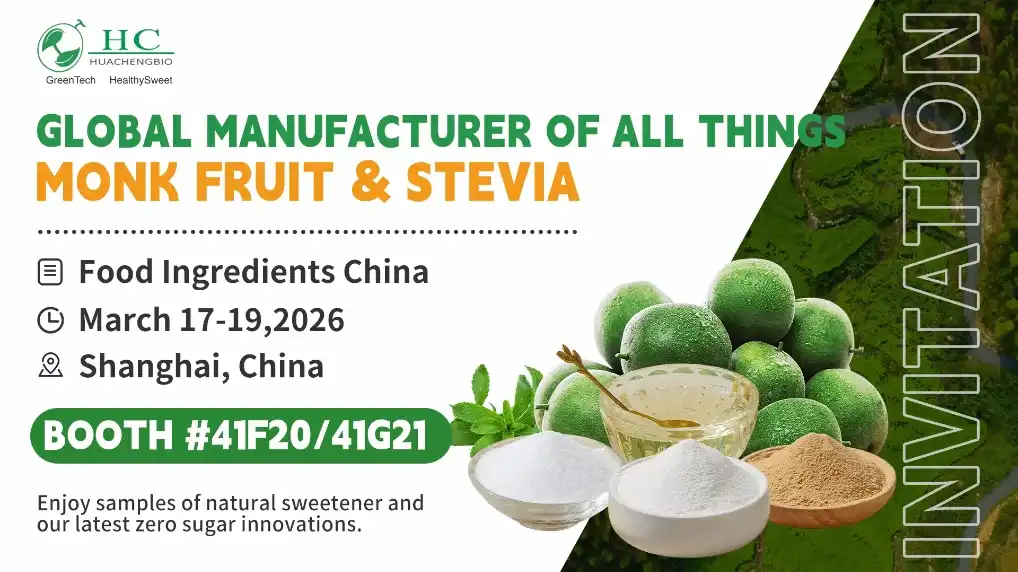
Join Us at Food Ingredients China (FIC) 2026! March 17–19, 2026 Hall 4.1 | Booth...

As a global leader in natural, health‑forward sweetening solutions, we will be present at ...
Products
FAQ
Standard samples are 50% or 80% mogroside V. If you need 40%, 60%, or another content, just ask—we can match it from our production batches.
The sample itself is free. You cover shipping. We ship via standard courier; delivery time depends on your location.
Because we pull samples directly from production lots, not from a separate lab batch. The COA reflects the spec you’d see on a full 25 kg drum. We also archive retention samples, so if you ever want to cross-check, the data is there.
Yes. Our default options are 80 mesh and 200 mesh. For very fine or granulated formats, we can mill a small quantity on request—just tell us your target particle size distribution.
In water-like systems, monk fruit tends to have a cleaner sweetness onset and less lingering bitterness compared to typical Reb A stevia. It’s also more heat-stable for pasteurization. You can test this head-to-head with the sample; we usually recommend starting at a 0.02–0.05% usage rate for 5% sugar equivalence, depending on your base.
Share your product type, target capacity, and application requirements. Our team can review the details and recommend a practical next step.